SEO for Contractors: How to Get More Local Leads from Google
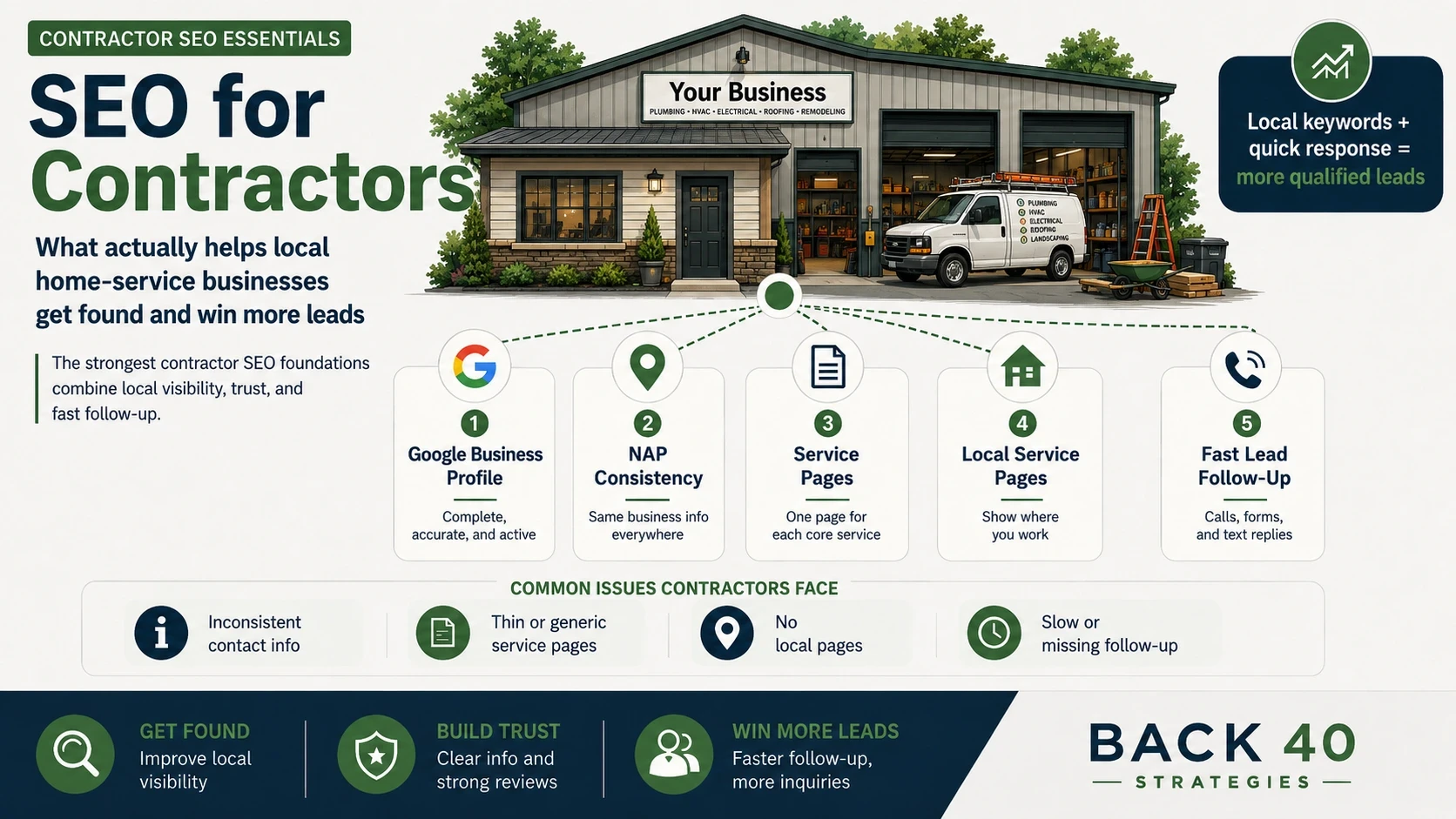
A contractor does not need thousands of website visitors from across the country.
A plumber in eastern North Carolina needs to appear when a nearby homeowner searches for help with a leaking pipe. An HVAC company needs to be visible when someone’s air conditioner stops working in the middle of July. A roofer needs to show up when a homeowner discovers storm damage and starts comparing local companies.
That is the real purpose of SEO for contractors: helping the right customers find your business in the areas you actually serve.
Unfortunately, many home-service companies are either difficult to find online or unprepared to respond when a potential customer reaches out.
After auditing more than 15 websites for plumbers, HVAC companies, roofers, landscapers, general contractors and other home-service businesses, I found that roughly 80% were not properly optimized for local search. Common problems included inconsistent business information, thin service pages, little mention of the company’s location and contact forms that did not lead to a timely response.
These problems do more than hurt rankings. They cost contractors real leads.
This guide explains how SEO for contractors works, what home-service businesses should prioritize and how to turn local search visibility into more calls, estimate requests and booked jobs.
What Is SEO for Contractors?
SEO, or search engine optimization, is the process of improving a business’s online presence so it can appear when potential customers search for relevant services.
For contractors, those searches might include:
Plumber near me
Emergency electrician in Jacksonville, NC
HVAC repair in Onslow County
Roof replacement company
Landscaping services near me
Septic pump repair
General contractor in my area
SEO for home-service businesses usually includes:
Google Business Profile optimization
Local keyword research
Service-page development
Location and service-area pages
NAP consistency
Online reviews
Technical website improvements
Mobile optimization
Local business listings
Helpful website content
Lead tracking and follow-up systems
The goal is not simply to increase traffic. It is to attract local customers who need the services you provide and make it easy for them to contact you.
Contractors Do Not Have to Compete Nationally
One of the biggest misconceptions I see is that SEO means competing with every contractor in the country for broad, highly competitive keywords.
A local plumber does not necessarily need to rank nationally for a broad phrase like “plumbing services.” That search may be highly competitive and may attract people who live nowhere near the company’s service area.
A more realistic and profitable strategy is to target local search terms with clear intent and lower competition.
For example:
Emergency plumber in Jacksonville, NC
Water heater repair in Richlands, NC
HVAC company near Camp Lejeune
Roof repair in Swansboro, NC
Landscaper in Onslow County
These terms may receive fewer total searches than broad national keywords, but the people searching them are much more relevant to a local contractor.
This is where strategic local keyword research matters. Rather than chasing the keyword with the biggest search volume, contractors should identify phrases that balance:
Local relevance
Search intent
Keyword difficulty
Service profitability
Realistic ranking potential
A lower-volume local keyword can be far more valuable than a national keyword if it consistently generates qualified calls and estimate requests.
Why Local SEO Matters for Home-Service Businesses
Contractors serve specific geographic areas. A roofing company in North Carolina does not benefit from attracting homeowners in Arizona. An HVAC contractor that serves three nearby counties does not need traffic from the entire country.
It needs to be visible locally.
Local SEO helps contractors appear in:
Google Maps
Local map results
“Near me” searches
City-specific searches
Service-area searches
Traditional organic search results
AI-generated search recommendations
Search tools increasingly use information from business websites, local listings, reviews, service pages and other credible online sources to understand which businesses operate in a specific area.
That makes clear locality especially important.
A contractor website should make it easy for both customers and search platforms to understand:
What services the company provides
Where the company operates
Which cities and communities it serves
How customers can get in touch
Why the business is credible
Many contractor websites explain what the company does but barely mention where it does it. That makes it harder to build relevance for local searches.
1. Make Your Name, Address and Phone Number Consistent
One of the most common problems I find during contractor website audits is inconsistent business information.
Your business name, address and phone number are commonly referred to as your NAP information.
This information may appear on:
Your website
Google Business Profile
Facebook
Yelp
Bing
Apple Maps
Chamber of commerce listings
Contractor directories
Industry associations
Old business profiles
Problems occur when those sources display different information.
For example:
Your website has a new phone number, but directories show the old one.
Your business name is formatted differently across several platforms.
An old address still appears online.
Your hours are incorrect.
You have duplicate Google or directory listings.
Your website URL is wrong on third-party profiles.
These inconsistencies can confuse customers and make it more difficult for search platforms to verify the business.
Start by deciding on one standard version of your:
Business name
Address, when publicly displayed
Primary phone number
Website URL
Business hours
Then review the most important online platforms and correct anything that does not match.
Service-area businesses should also configure their listings properly. If customers do not visit your business address, you may need to hide the address publicly and clearly define the areas you serve.
Learn more in Back40 Strategies’ guide to [NAP consistency and why it matters for local SEO]([INSERT NAP BLOG URL]).
2. Optimize Your Google Business Profile
For many contractors, the Google Business Profile is one of the most important parts of the company’s online presence.
It may be the first thing a homeowner sees when searching for local help. It can display:
Reviews
Photos
Services
Business hours
Phone number
Website
Service area
Directions
Contact options
A complete and accurate profile helps customers quickly determine whether the company is relevant to their needs.
Choose the Right Primary Category
Your primary category should represent the company’s main service as accurately as possible.
For example, a plumbing company should generally select a specific plumbing-related category rather than a vague general category. Additional categories can be included when they accurately reflect meaningful services the company provides.
Avoid adding unrelated categories solely to appear in more searches.
List Your Services
Your profile should clearly identify the services customers can hire you to perform.
A plumbing company might list:
Leak repair
Drain cleaning
Water heater repair
Water heater installation
Sewer line repair
Fixture installation
Emergency plumbing
An HVAC company might include:
Air-conditioning repair
Heating repair
System installation
Preventive maintenance
Indoor air-quality services
Emergency HVAC service
These details help customers understand your business and strengthen the connection between your company and relevant searches.
Add Real Photos
Contractors have a major advantage when it comes to visual proof: the work itself.
Use original photos of:
Completed projects
Before-and-after results
Team members
Work vehicles
Equipment
Projects in progress
Finished details
Real photos help potential customers verify that you actually perform the services you advertise.
3. Build a Page for Each Important Service
Many contractor websites place every service on one short page.
A plumbing company might list drain cleaning, water heaters, leak repair, sewer work and fixture installation in a few paragraphs. While this gives visitors a basic overview, it does not provide enough detail for each service.
Important services should have dedicated pages.
For example:
/drain-cleaning/water-heater-repair/sewer-line-repair/emergency-plumbing
A roofing company might create separate pages for:
Roof inspections
Roof repairs
Roof replacement
Storm damage
Metal roofing
Commercial roofing
Each page should explain:
What the service includes
Common signs that the service is needed
Problems the service addresses
The company’s process
Factors that may affect cost
Areas where the service is available
Reasons customers should trust the company
The next step to request help
This makes the website more useful for customers and gives search platforms a clearer understanding of each service.
4. Create Strong Local Service Pages
Local service pages are a must for contractors that want to improve their visibility in specific cities and communities.
A general service page tells search platforms what you do. A local service page helps explain where you do it.
Examples might include:
Plumbing services in Jacksonville, NC
HVAC repair in Richlands, NC
Roofing contractor in Swansboro, NC
Landscaping services in Onslow County
Septic services near Camp Lejeune
However, contractors should not create dozens of identical pages and only change the city name.
A useful local page should contain information that is genuinely relevant to that area, such as:
Services offered in that location
Nearby communities or neighborhoods
Local project examples
Testimonials from customers in the area
Original project photos
Common local problems
Types of properties commonly served
Scheduling or travel considerations
Relevant climate or environmental conditions
A clear way to request service
For example, an HVAC company serving eastern North Carolina could discuss the importance of reliable cooling during prolonged periods of high heat and humidity. A septic company might address common warning signs that require prompt service in rural properties.
These details make the page useful instead of treating the location as an excuse to repeat the same content.
5. Match the Keyword to the Correct Type of Page
Not every keyword should lead to a blog post.
Some searches indicate that the customer is ready to hire. Others show that the person is still researching a problem.
The page type should match that intent.
Search intent | Best page type | Example |
|---|---|---|
Ready to hire | Service page | Emergency plumber in Jacksonville, NC |
Looking for a provider | Local service page | Roofing contractor in Swansboro, NC |
Researching a problem | Blog or guide | Why is my water pressure low? |
Comparing options | Guide or service page | Repair or replace a water heater? |
Searching for the company | Homepage or Google profile | ABC Plumbing phone number |
A contractor should not try to rank a general blog post for every high-value service keyword.
The primary service pages should target customers who are actively looking to hire. Blog content should support those pages by answering related questions and building subject-matter authority.
6. Ask for and Respond to Reviews
Reviews matter because customers often compare several local businesses before choosing one.
A company with recent, detailed reviews may appear more active and trustworthy than one with only a few old reviews.
The best time to ask for a review is usually shortly after a successful job.
A simple process could be:
Confirm that the customer is satisfied.
Send a direct Google review link.
Follow up once if necessary.
Respond after the review is posted.
The request can be sent by text or email, making it easier for the customer to complete.
Contractors should respond professionally to both positive and negative reviews. A thoughtful response shows future customers that the company communicates and takes feedback seriously.
7. Make the Website Easy to Use on a Phone
Many contractor searches happen on mobile devices, especially when the customer has an urgent problem.
A homeowner dealing with a broken air conditioner, overflowing septic system, leaking pipe or electrical issue is not going to spend several minutes searching through a complicated website.
The website should immediately answer:
Do you provide the service I need?
Do you serve my location?
Are you available?
Can I trust you?
How do I contact you?
A strong contractor website should include:
A visible phone number
Click-to-call functionality
A short contact form
Clear service information
Service areas
Reviews
Real project photos
Licensing or credential information
Fast loading times
Simple mobile navigation
Clear calls to action
Do not hide the phone number at the bottom of the page or require someone to complete a long form before requesting help.
8. Test Every Link, Form and Contact Method
A contact form is not useful if no one receives the submission.
During a website audit, every important customer path should be tested.
That includes:
Phone-number links
Contact forms
Request-an-estimate forms
Appointment links
Email links
Social media links
Navigation menus
Calls to action
Thank-you pages
Submit the forms yourself and confirm:
The submission goes through
The right person receives a notification
The lead information is recorded
The customer receives confirmation
Someone follows up promptly
Broken links and forms can quietly cost a business leads for weeks or months.
9. Respond Before the Customer Calls Someone Else
Contractors often spend money generating leads but do not have a system for responding quickly.
During outreach to more than 50 locally owned home-service businesses, roughly 90% of my calls went to voicemail. In most cases, there was no automated text, no immediate acknowledgment and no follow-up.
I was conducting business outreach, but I could easily have been a homeowner looking for service.
That is especially important for urgent industries such as:
Plumbing
Electrical work
HVAC repair
Septic services
Water-damage restoration
Roofing after a storm
Imagine that a homeowner’s air-conditioning system stops working during a North Carolina heat wave. They call three HVAC companies.
The first call goes to voicemail with no response.
The second company has a contact form, but no one responds until the next day.
The third company misses the call but immediately sends a text confirming that the message was received and asking for the customer’s name, address and service need.
The third company has already moved the conversation forward.
Contractors are often on job sites and cannot answer every call personally. The problem is not always a lack of effort. It may be a lack of bandwidth or a system that relies too heavily on manual follow-up.
That is where automation can help.
A missed-call text or form confirmation can:
Let the customer know the message was received
Collect basic service information
Set expectations about response time
Alert the appropriate team member
Keep the customer from immediately calling the next business
Record the lead for future follow-up
Back40 Central can help contractors centralize calls, forms, text messages and follow-up communication. It does not replace personal service, but it can make sure an opportunity is not lost simply because the team is working in the field.
10. Publish Content Based on Real Customer Questions
Contractors already have access to valuable content ideas through:
Phone calls
Text messages
Estimate requests
Sales conversations
Customer objections
Technician questions
Pay attention to what customers ask repeatedly.
Examples include:
How much will this cost?
Is this an emergency?
Can this be repaired?
Does this need to be replaced?
How long will the work take?
What caused the problem?
Will insurance cover it?
How can I prevent it from happening again?
What should I do before the technician arrives?
These questions can become useful articles, FAQs, videos and service-page sections.
Examples include:
How Much Does Water Heater Replacement Cost?
Should You Repair or Replace Your Roof?
What to Do When Your Air Conditioner Stops Working
Signs Your Septic Pump May Be Failing
How Long Does a Bathroom Remodel Take?
Why Does My Circuit Breaker Keep Tripping?
The strongest contractor content includes firsthand expertise, such as:
Common mistakes
Real project examples
Original photos
Technician insights
Local considerations
Specific recommendations
Honest limitations
Publishing generic content solely to add keywords is unlikely to distinguish the business from every other contractor using the same strategy.
11. Improve Website Speed and Technical Performance
A slow or poorly functioning website can frustrate potential customers and make it harder for search platforms to access the content.
A contractor SEO audit should review:
Mobile performance
Page-load speed
Large image files
Broken links
Missing page titles
Missing meta descriptions
Heading structure
Image alt text
Indexing problems
Duplicate pages
Security and HTTPS
Redirect errors
Contact-form performance
Local structured data
Technical improvements should support the customer experience.
A website does not need complicated animations or advanced features to perform well. It needs to load quickly, work consistently and make the company’s services easy to understand.
12. Build Local Authority
Backlinks are links from other websites to yours. They can help establish credibility, but quality and relevance matter more than simply accumulating a large number of links.
Potential local and industry sources include:
Chambers of commerce
Trade associations
Supplier directories
Manufacturer websites
Local news outlets
Community organizations
Sponsorships
Business groups
Industry certifications
Local events
Project partners
Contractors can also look at existing business relationships.
A general contractor may regularly work with electricians, plumbers, designers, real estate professionals and suppliers. These relationships may create legitimate opportunities for project features, educational content or partner listings.
Avoid buying hundreds of low-quality links from unrelated websites. A smaller number of relevant local mentions is usually a stronger long-term foundation.
13. Track Leads, Not Just Rankings
Rankings are useful, but rankings alone do not pay the bills.
A contractor may rank for a high-volume keyword that produces little business. Another lower-volume local phrase might generate several profitable projects.
Track metrics such as:
Phone calls from organic search
Contact-form submissions
Estimate requests
Booked appointments
Google Business Profile interactions
Leads by service
Leads by location
Conversion rate
Response time
Closed jobs
Revenue associated with organic leads
The most important question is not:
Did website traffic increase?
It is:
Did more qualified local customers contact the business?
What Should a Contractor Fix First?
SEO can feel overwhelming because there are many possible improvements. Start with the problem that is closest to the lead.
You are not appearing in local searches
Prioritize:
Google Business Profile optimization
NAP consistency
Local keyword research
Service pages
Local service pages
Reviews
You appear in search but receive few clicks
Review:
Page titles
Meta descriptions
Review quantity and quality
Google profile photos
Service descriptions
Brand credibility
People visit the website but do not contact you
Improve:
Mobile usability
Page speed
Phone-number visibility
Calls to action
Contact forms
Trust signals
Project photos
Service explanations
You receive inquiries but few become jobs
Examine:
Response time
Missed-call procedures
Automated confirmations
Lead qualification
Estimate follow-up
Message tracking
Scheduling process
SEO should not be treated as separate from the rest of the customer journey. Visibility only produces value when the business can convert that visibility into a conversation.
A Practical 90-Day Contractor SEO Plan
Month 1: Fix the Foundation
Audit the website and Google Business Profile
Test every link and form
Review mobile usability
Check page speed
Correct major NAP inconsistencies
Install call and form tracking
Identify priority services and locations
Research realistic local keywords
Month 2: Strengthen Local Relevance
Improve the highest-value service pages
Build one or two useful local service pages
Optimize titles and descriptions
Add internal links
Add original project photos
Begin a consistent review-request process
Improve Google Business Profile services and categories
Month 3: Build Authority and Improve Conversion
Publish content based on customer questions
Pursue relevant local mentions and backlinks
Improve forms and calls to action
Add missed-call and form-response automation
Review lead quality
Compare results by service and location
Adjust priorities based on actual inquiries
The exact order will vary, but the process should begin with correcting foundational issues before producing large amounts of new content.
What Is Included in a Contractor SEO Audit?
A contractor SEO audit should evaluate more than keyword rankings.
At Back40 Strategies, a digital audit may review:
Broken links
Mobile usability
Website speed
Contact forms
Lead-response systems
Page structure
Service-page depth
Local service pages
NAP consistency
Google Business Profile information
Calls to action
Website trust signals
Indexing issues
Page titles and descriptions
Local keyword opportunities
Review visibility
Conversion paths
Lead tracking
The purpose is to identify what may be preventing the business from getting found, contacted or chosen.
Common Contractor SEO Mistakes
The most common problems include:
Inconsistent business information
No local service pages
Little mention of the company’s location
Every service placed on one short page
Generic or duplicated city pages
Slow mobile performance
Broken forms or links
No lead tracking
No automated response process
Delayed follow-up
Outdated Google Business Profile information
Few recent reviews
Reliance on broad national keywords
Publishing generic content
Measuring traffic without measuring leads
A successful contractor SEO strategy connects the website, local search presence, reputation and follow-up process.
Contractor SEO Should Generate More Than Traffic
Home-service companies do not need more random website visitors.
They need local homeowners who are actively looking for the services they provide.
A strong SEO strategy should help a contractor:
Rank for realistic local searches
Appear in the communities it serves
Explain its services clearly
Establish trust
Generate calls and estimate requests
Respond before the customer moves on
Track which marketing efforts lead to revenue
That requires more than adding keywords to a website. It requires a complete system built around how local customers search, compare and hire contractors.
Find Out What Is Limiting Your Local Visibility
Back40 Strategies helps home-service businesses improve their websites, local search visibility and lead follow-up systems.
A free digital audit can identify problems with your website, Google presence, local keywords, contact process and overall customer experience.
Request your free digital audit and find out which improvements could have the greatest impact on your local visibility and lead generation.