What Is NAP Consistency? Why It Matters for Local SEO
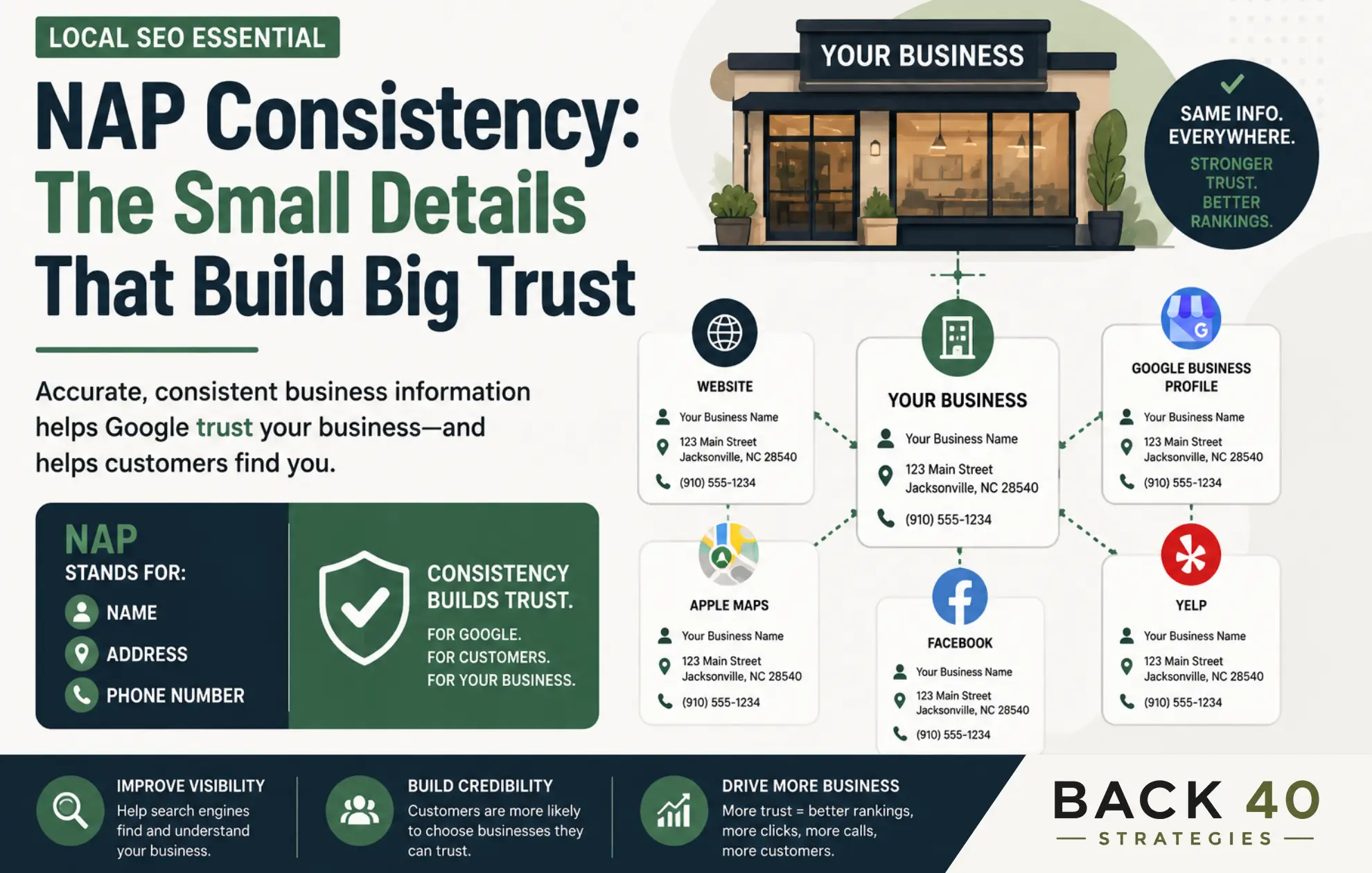
NAP consistency is the practice of keeping your business's name, address, and phone number (NAP) accurate and consistent across every online business listing, including your website, Google Business Profile, Apple Maps, Yelp, Facebook, and other local citations. In local SEO, consistent business information helps customers find you while giving Google confidence that your business is legitimate, making NAP consistency an important part of improving your visibility in local search results.
Now that you know what it is, let's talk about why it matters.
Imagine you're looking for a local plumber. You find one with great reviews, but when you call the phone number listed on Yelp, it's disconnected. You check Google Maps and it sends you to an old address. Frustrated, you move on to the next business.
Unfortunately, that happens more often than business owners realize.
When customers—and search engines—find conflicting information about your business, it creates confusion. While Google has become much better at recognizing small formatting differences, outdated or incorrect information can still hurt your visibility in local search and, more importantly, cost you potential customers.
The good news? Fixing NAP consistency is one of the most straightforward ways to strengthen the foundation of your local SEO.
In this guide, you'll learn what NAP consistency is, why it matters, how to check your business listings, and the practical steps you can take to keep your information accurate across the web.
What Is NAP Consistency?
NAP stands for Name, Address, and Phone Number.
NAP consistency simply means that your business's name, address, and phone number are accurate and consistent everywhere they appear online.
That includes places like:
Your website
Your Google Business Profile
Apple Maps
Bing Places
Yelp
Facebook
Local business directories
Chamber of Commerce websites
Industry-specific directories
Some marketers also include your website URL, referring to it as NAPW (Name, Address, Phone Number, Website). While you may see that term occasionally, most people simply refer to it as NAP consistency.
What does "consistent" actually mean?
Let's look at an example.
Consistent Listings
Back40 Strategies
123 Main Street
Jacksonville, NC 28540
(910) 555-1234
That exact information appears on:
Your website
Google Business Profile
Facebook
Yelp
Apple Maps
Everything matches.
Now compare that with this:
Inconsistent Listings
Website
Back40 Strategies
123 Main Street
(910) 555-1234
Google Business Profile
Back Forty Strategies
125 Main St.
(910) 555-1234
Back40 Marketing
123 Main Street
(910) 555-9876
Yelp
Back40 Strategies
123 Main Street
(910) 555-1234
Can a customer figure out which one is correct? Probably.
Can Google? Usually.
But you've just introduced unnecessary uncertainty.
The more uncertainty search engines have about your business, the harder it becomes for them to confidently recommend you.
What Is a Local Citation?
You'll hear another term come up often when talking about NAP consistency:
Local citation.
Don't let the name intimidate you.
A local citation is simply any website that mentions your business's name, address, and phone number.
That's it.
Some common examples include:
Google Business Profile
Apple Maps
Yelp
Better Business Bureau
Facebook
LinkedIn
Your local Chamber of Commerce
Industry directories
Think of each citation as another place where Google can verify that your business is real.
The more trustworthy sources that agree on your business information, the easier it is for search engines to trust what they're seeing.
Does Everything Have to Match Exactly?
This is one of the biggest misconceptions in local SEO.
Years ago, many marketers believed every comma, abbreviation, and dash had to be identical everywhere online.
Today, that's simply not true.
Google has become much better at understanding common variations.
For example:
Street vs. St.
Avenue vs. Ave.
Suite vs. Ste.
(910) 555-1234 vs. 910-555-1234
These minor formatting differences usually aren't a problem.
Accuracy matters more than perfection.
If your address is correct, your phone number is current, and your business name is accurate, Google is generally smart enough to understand those small formatting differences.
Where businesses run into trouble is when the information itself changes.
For example:
An old phone number is still listed on Facebook.
Yelp still has your previous address.
Google Business Profile uses your legal business name, while your website uses a completely different brand name.
You created duplicate listings years ago and forgot about them.
Those are the inconsistencies worth fixing.
Why NAP Consistency Matters for Local SEO
At its core, Google's job is surprisingly simple.
It wants to recommend businesses it trusts.
Every time Google finds your business listed online, it's collecting another piece of information about who you are, where you're located, and how customers can reach you.
When every source agrees, Google gains confidence.
When those sources disagree, confidence decreases.
Think of it like meeting someone new.
If five people all introduce the same person using the same name, job title, and phone number, you'd probably trust that information.
But if each person tells you something different, you'd naturally start questioning which version is correct.
Google works in much the same way.
That's one reason NAP consistency continues to matter for local SEO, even as search algorithms become more sophisticated.
However, it's important to keep one thing in perspective.
NAP consistency isn't a magic ranking trick.
Having perfectly consistent business listings won't automatically put you at the top of Google.
Instead, it creates a solid foundation that supports everything else you're doing—from collecting reviews and optimizing your Google Business Profile to publishing helpful content and earning local backlinks.
Think of it this way:
A beautiful house built on a weak foundation will eventually develop problems.
The same is true for your local SEO.
How to Check NAP Consistency
Checking your NAP consistency means reviewing every major place your business is listed online and making sure your name, address, and phone number are accurate. The goal isn't to have your business listed on hundreds of websites—it's to ensure the listings that matter most all contain the correct information.
The good news? You don't need expensive software to perform a basic NAP audit. In fact, most small business owners can identify the biggest issues in about 30 minutes.
Step 1: Start With Google
Search for your business name exactly as your customers would.
For example:
"Back40 Strategies"
Then search:
"Back40 Strategies Jacksonville NC"
Take note of every place your business appears.
Look for:
Is your business name spelled the same everywhere?
Is your address correct?
Does every listing use your current phone number?
Are there duplicate listings?
Is Google showing outdated information?
If you recently moved, changed phone numbers, or rebranded your business, this is often where inconsistencies start to appear.
Back40 Tip: Open your website and your Google Business Profile side by side. Your business name, address, phone number, business hours, and website URL should all match.
Step 2: Check Your Most Important Business Listings
Once you've reviewed Google's search results, compare your information across the platforms that have the biggest impact on local visibility.
Don't worry if you're not listed on every directory imaginable.
Quality matters much more than quantity.
It's better to have 15 accurate listings than 300 outdated ones.
Step 3: Compare Your NAP
Now compare every listing against your website.
Your website should act as the source of truth for your business information.
Ask yourself:
Does my business name match exactly?
Is my address current?
Is my phone number correct?
Does every listing link to the correct website?
Are my business hours accurate?
Minor differences like Street vs. St. or Suite vs. Ste. generally aren't worth worrying about. Google is smart enough to understand common abbreviations.
Instead, focus on meaningful differences.
For example:
Wrong phone number
Previous address
Duplicate Google Business Profile
Old business name
Incorrect website
Those are the issues that deserve your attention first.
Step 4: Search for Duplicate Listings
Duplicate listings are one of the most common local SEO issues, especially for businesses that have:
Moved locations
Changed names
Switched phone numbers
Worked with multiple marketing agencies over the years
To find duplicates, search variations of your business.
For example:
"Back40 Strategies"
"Back Forty Strategies"
Your current phone number
Your old phone number
Your address
You may discover listings you forgot existed years ago.
If Google sees multiple listings for what appears to be the same business, it has to determine which one is correct. Customers face the same challenge.
Whenever possible, claim duplicate listings and either update or remove them.
Step 5: Don't Forget Your Website
Many businesses focus so much on Google Business Profile that they forget to audit their own website.
Double-check that your name, address, and phone number appear consistently on:
Contact page
Website footer
Website header (if applicable)
Location pages
Schema markup
Appointment or booking pages
If you have multiple locations, each location should have its own dedicated page with its own NAP information.
Avoid placing your contact information inside images whenever possible. Search engines read text much more reliably than text embedded in graphics.
A Simple 30-Minute NAP Audit Checklist
If you're not sure where to begin, work through this checklist:
✅ Website
✅ Google Business Profile
✅ Apple Maps
✅ Bing Places
✅ Yelp
✅ Better Business Bureau
✅ Chamber of Commerce
✅ Industry directories
✅ Duplicate listings
✅ Old phone numbers
✅ Old addresses
✅ Website footer and contact page
By the end of this process, you'll have a much clearer picture of how consistent your business information really is.
And don't be surprised if you find a few inconsistencies along the way. Even well-established businesses often discover outdated listings that have been sitting unnoticed for years.
Why This Matters More Than You Might Think
Finding inconsistencies isn't just about making Google happy.
Imagine a customer is ready to visit your business, but Apple Maps sends them to your old location. Or they call the phone number they found on Yelp only to hear it's been disconnected.
In that moment, they probably won't spend time investigating what happened—they'll simply choose another business.
That's why I always tell business owners that NAP consistency is just as much about customer experience as it is about SEO. Every accurate listing makes it easier for people to find you, contact you, and trust that they're in the right place.
How to Improve NAP Consistency
Improving NAP consistency is less about adding your business to hundreds of directories and more about making sure your information is accurate everywhere your customers are likely to find you.
Years ago, many SEO agencies sold citation packages that promised to submit your business to hundreds or even thousands of directories. Today, that's no longer the best use of your time or budget.
Google has become much better at understanding businesses, and there are far more important ranking factors than simply having your business listed on every directory imaginable.
Instead, focus on building a strong foundation by updating the places that matter most.
1. Make Your Website Your Source of Truth
Before updating any directories, start with your website.
Why?
Because your website is the one place you completely control. It's also one of the first places Google looks to verify your business information.
Review your:
Contact page
Website footer
Website header (if your phone number appears there)
Location pages
Appointment or booking pages
Make sure your business name, address, phone number, and website URL are accurate.
If you've recently moved or changed phone numbers, this should always be your first update.
Back40 Tip: If Google finds conflicting information between your website and your business listings, your website should be the version you trust. Update it first, then work outward.
2. Optimize Your Google Business Profile
If your website is your digital home, your Google Business Profile is your digital storefront.
For many businesses, it's the first thing potential customers see before they ever visit your website.
Make sure your profile includes:
Correct business name
Current address
Primary phone number
Website link
Business hours
Services
Business categories
While you're there, check for duplicate profiles.
Duplicate Google Business Profiles can split reviews, confuse customers, and make it harder for Google to determine which listing is the correct one.
3. Update Major Business Directories
Once your website and Google Business Profile are correct, move on to the platforms that carry the most authority.
These typically include:
Apple Maps
Bing Places
Facebook
Yelp
Better Business Bureau
Your local Chamber of Commerce
Industry-specific directories
If your business appears on these sites, your information should match your website as closely as possible.
Remember, perfection isn't the goal, accuracy is.
4. Remove or Update Duplicate Listings
One of the biggest local SEO issues I encounter is duplicate listings.
They often happen after:
Moving locations
Rebranding
Switching marketing agencies
Creating multiple Google Business Profiles
Automatically generated directory listings
If customers see multiple versions of your business online, they won't know which one to trust.
Neither will Google.
Whenever possible, claim duplicate listings and either merge, remove, or update them.
5. Keep Track of Where Your Business Is Listed
As your business grows, it's easy to forget where you've created profiles over the years.
Create a simple spreadsheet with columns for:
Website
Username or login
Listing URL
Last updated date
Notes
The next time you move locations or change phone numbers, you'll know exactly where updates need to be made.
It's a small habit that can save hours of work later.
Common NAP Consistency Mistakes
Even businesses with strong local SEO can make mistakes. The good news is that most are easy to fix once you know what to look for.
Using an Old Phone Number
This is one of the most common issues. Maybe you changed providers, switched to a new business line, or started using a mobile number. If even one major directory still displays the old number, customers may call the wrong line, or assume you've gone out of business.
Forgetting to Update After Moving
Moving offices involves a long checklist, and updating business listings often gets pushed to the bottom. Unfortunately, outdated addresses don't just confuse Google—they frustrate customers.
If you've relocated, update your:
Website
Google Business Profile
Apple Maps
Bing Places
Facebook
Yelp
before worrying about smaller directories.
Inconsistent Business Names
Your legal business name doesn't always match the name customers recognize.
For example:
ABC Heating & Air Conditioning, LLC
versus
ABC Heating & Air
Choose the version that aligns with your branding and Google Business Profile, then use it consistently across your website and listings.
Avoid stuffing your business name with keywords like:
ABC Heating & Air | Best HVAC Company Jacksonville NC
Not only does it look unprofessional, but it also violates Google's guidelines for business names.
Creating Multiple Listings
Sometimes business owners accidentally create a new Google Business Profile instead of updating an existing one. Other times, old listings remain active after a move. Duplicate listings can split reviews, create conflicting information, and make it harder for customers to find the correct location.
If you discover duplicates, claim and merge or remove them whenever possible.
Worrying About Minor Formatting Differences
This is where a lot of outdated SEO advice still circulates online.
You've probably heard things like:
Every listing has to match exactly.
Thankfully, that's no longer true.
Google understands common abbreviations.
For example:
Street vs. St.
Road vs. Rd.
Suite vs. Ste.
(910) 555-1234 vs. 910-555-1234
These small formatting differences typically won't hurt your rankings. Instead, spend your time fixing information that's actually incorrect. That's where you'll see the greatest benefit.
Ignoring Your Website's Structured Data
Here's one technical term that's worth learning:
Structured data, sometimes called schema markup, is a small piece of code that helps search engines better understand the information on your website. Think of it like attaching a label to your business details. Your customers never see it, but Google does.
If your schema lists an old address or phone number, it sends conflicting signals—just like an outdated directory listing would. The good news is that most modern website platforms and SEO plugins make updating this information straightforward.
Does Call Tracking Hurt NAP Consistency?
Many business owners avoid call tracking because they've heard it can negatively affect local SEO.
In most cases, that's a myth.
Modern call tracking platforms use Dynamic Number Insertion (DNI), which displays different phone numbers to visitors based on how they found your website while still allowing search engines to see your primary business number.
In other words, you can measure which marketing campaigns generate phone calls without sacrificing NAP consistency, as long as your system is configured correctly.
If you're using call tracking, make sure your primary business number remains the official number across your website, Google Business Profile, and major business listings.
Back40 Tip: Don't spend weeks chasing down every tiny directory on the internet. Update your website, Google Business Profile, and major business listings first. Those updates will have the biggest impact on both your customers and your local SEO.
Does NAP Consistency Still Matter?
Yes, but probably not in the way you've been led to believe.
If you've read older SEO articles, you might think that simply cleaning up your business listings will send you to the top of Google's search results. Unfortunately, local SEO isn't that simple anymore.
Today's search algorithms look at hundreds of signals when deciding which businesses to show in local search results. NAP consistency is still one of those signals, but it's best thought of as a foundational ranking factor, not the deciding factor.
Think of it like opening a new restaurant.
Having the correct address on your front door won't make you the busiest restaurant in town, but having the wrong address certainly won't help.
The same principle applies to your online presence.
Accurate business information helps Google trust your business, but trust alone isn't enough to earn top rankings.
Today, Google is also evaluating factors like:
The quality and completeness of your Google Business Profile
Customer reviews and how frequently you receive them
The relevance and quality of your website content
Local backlinks from reputable organizations
Website speed and mobile usability
Your overall online reputation
How well your website answers the questions people are searching for
NAP consistency supports all of these efforts by giving Google confidence that the information it's finding across the web is accurate.
NAP Consistency and AI Search
Search is changing quickly.
Instead of only searching Google, people are increasingly asking questions in tools like ChatGPT, Gemini, Claude, and Perplexity. While each platform gathers information differently, they all have one thing in common: They work best when they can confidently verify information from multiple trustworthy sources.
If your website says one thing, your Google Business Profile says another, and Apple Maps shows something different, those mixed signals don't just confuse customers—they can also reduce confidence in AI-generated answers.
No one outside of these companies knows the exact formulas they use, but one thing is clear: consistent, trustworthy business information has become more important, not less.
That's why I encourage businesses to think beyond traditional SEO.
You're not just optimizing for Google anymore. You're building a digital presence that's easy for both people and technology to trust.
Frequently Asked Questions
What is NAP consistency?
NAP consistency means keeping your business's name, address, and phone number accurate and consistent across your website, Google Business Profile, social media profiles, and online business directories. Consistent information helps customers find your business and supports your local SEO efforts.
How do I check NAP consistency?
Start by comparing your website with your Google Business Profile, then review major business listings like Apple Maps, Bing Places, Facebook, and Yelp. Look for outdated addresses, incorrect phone numbers, duplicate listings, or inconsistent business names.
What is the significance of NAP consistency in local SEO?
NAP consistency helps search engines verify that your business information is accurate. While it's only one piece of local SEO, consistent business listings strengthen trust and reduce confusion for both customers and Google.
How do I improve NAP consistency?
Begin by updating your website, then your Google Business Profile, followed by your most important business directories. Remove duplicate listings, correct outdated information, and keep a record of every platform where your business is listed.
Does every listing have to match exactly?
Not necessarily.
Google understands common abbreviations like "Street" versus "St." or different phone number formatting. Focus on making sure the actual information is correct rather than worrying about every punctuation mark.
What is a local citation?
A local citation is any online mention of your business's name, address, and phone number. Examples include Google Business Profile, Yelp, Apple Maps, Facebook, industry directories, and local Chamber of Commerce websites.
How often should I check my business listings?
I recommend auditing your business listings at least twice a year and anytime your business changes its name, address, phone number, website, or hours of operation.